Planting a border: layout, spacing and a year-round bloom plan
By Hovenier Hoofddorp · Updated August 7, 2026
A good border works in three layers: tall and structural at the back, mid-height in the middle, low and ground-covering at the front. Plant densely enough (roughly 7 to 9 perennials per m²) and the border closes naturally within two seasons - the single best defence against weeds. Year-round interest comes from deliberately combining early, mid- and late-season bloomers with evergreen structure.
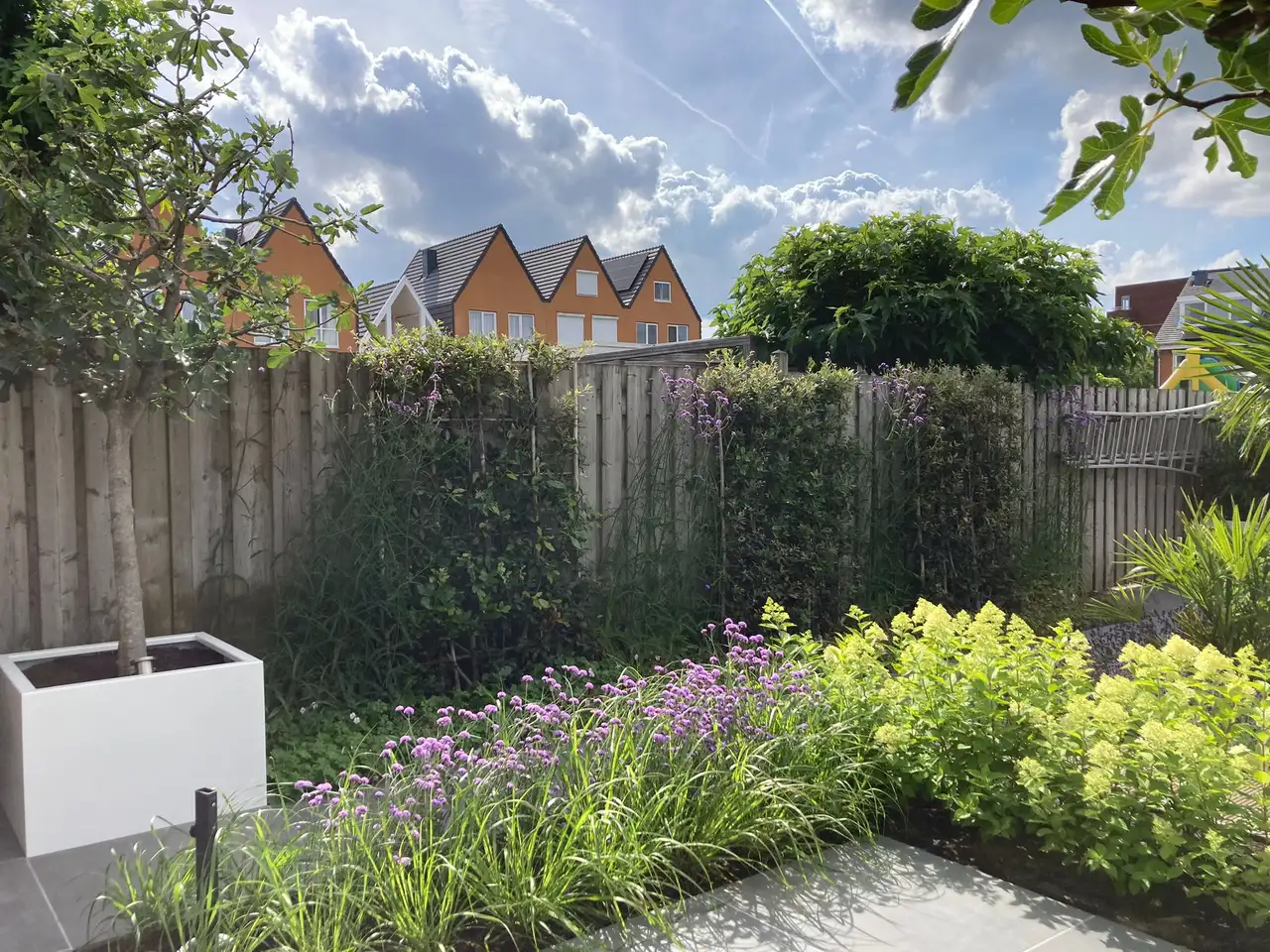
How do you build a border in three layers?
- Back layer (structure): shrubs and tall perennials at 100–200 cm - ornamental grasses, viburnum, hydrangea - give the border a backbone, even in winter.
- Middle layer (the main course): perennials at 40–80 cm that deliver most of the flowering - geranium, salvia, rudbeckia, astilbe.
- Front layer (finishing): low, ground-covering plants at 10–30 cm that close bare soil at the front and suppress weeds - lady's mantle, geranium macrorrhizum, low grasses.
Against a wall or fence, layer from back to front; for an island border (visible from all sides), place the tall layer in the middle and step down towards both edges.
How many plants do you need per m²?
| Plant type | Plants per m² |
|---|---|
| Large structural plants / shrubs | 1 – 3 |
| Medium perennials | 5 – 7 |
| Low ground covers | 9 – 12 |
| Average mixed border | 7 – 9 |
Plant in drifts of 3 or 5 of the same species (never in straight rows) - it reads more naturally and gives far more visual impact than scattered singles of everything.
How do you get flowers all year round?
- Spring (March–May): bulbs (daffodil, allium), lungwort, hellebore and the first geraniums.
- Early summer (June): roses, salvia, emerging ornamental grasses, first hydrangeas.
- Late summer (July–August): rudbeckia, echinacea, phlox, lavender - the high point of most borders.
- Autumn (September–October): sedum, aster, grasses in plume, Japanese anemone.
- Winter: evergreen structure (yew, sarcococca), and leave spent seedheads on grasses and echinacea standing for texture and bird food.
Aim for 30–40% of the border in evergreen or strongly structural plants - that stops the border from being a bare patch from November to March.
How do you build a border in practice?
- Mark the shape with a garden hose for a flowing line.
- Remove grass and weeds completely, including the roots of persistent species.
- Work 5–10 cm of compost into the top 20–30 cm of soil - on the clay of this region, this is the difference between plants establishing and drowning.
- Plant the structural layer first, then the middle layer, then the front layer - this avoids awkwardly squeezing small plants in later.
- Water generously at planting and mulch with 5 cm of compost or bark against drying out and weeds.
Want a border designed for your garden? See our planting plan service, including a soil and light inspection.
Frequently Asked Questions
How deep should I work the soil for a new border?
At least 20 to 30 cm deep, loosened and enriched with compost. On the clay soil of this region this matters even more: unworked clay is too dense for young roots to penetrate, so plants establish poorly even in the "right" spot on paper.
When is the best time to plant a border?
Autumn (September–November) is ideal: the soil is still warm, rainfall is naturally higher, and roots establish all winter, giving a head start in spring. Early spring (March–April) is the second-best option.
How do I stop weeds taking over a new border?
Plant densely enough (7–9 plants per m²) so the canopy closes within two seasons, and mulch bare soil immediately after planting with 5 cm of compost or bark. This suppresses germinating weed seed far more effectively than weed membrane, which tends to backfire in planted borders.
Hovenier Hoofddorp is your gardener for the greater Amsterdam area - from garden landscaping and garden maintenance to premium villa gardens with pools, nationwide. Fixed prices, reply within 24 hours.
Rather leave it to us? Request a quote.
We are happy to visit you for honest advice and a clear price. No hassle - just a well-kept garden, with everything explained in English.
Fast Response
We always respond within 24 hours, so you quickly know where you stand.
Professional Results
We work neatly and always leave your garden tidy. A deal is a deal.