Garden paving contractor in the Netherlands: costs and process
By Hovenier Hoofddorp · Updated August 7, 2026
A paving contractor lays patios, driveways and garden paths so they stay flat and stable for years - the difference almost always comes down to the foundation, not the stone itself. We combine paving work with gardening knowledge: useful for gardens where hardscaping, planting and drainage need to work together, and for traditional Dutch materials such as oud-Waalse klinkers, IJsselsteentjes and kinderkopjes that require specific laying expertise.
What does a paving contractor actually do?
A paving contractor handles the full job: removing old paving, excavating and compacting the ground, laying a stable sub-base, screeding the levelling sand with the correct fall, then laying the stones or slabs including jointing and compaction. On the heavy clay soil found across much of the Netherlands, that sub-base is critical - an undersized foundation is the most common cause of sunken paving within a few years. See our guide on fixing sunken paving.
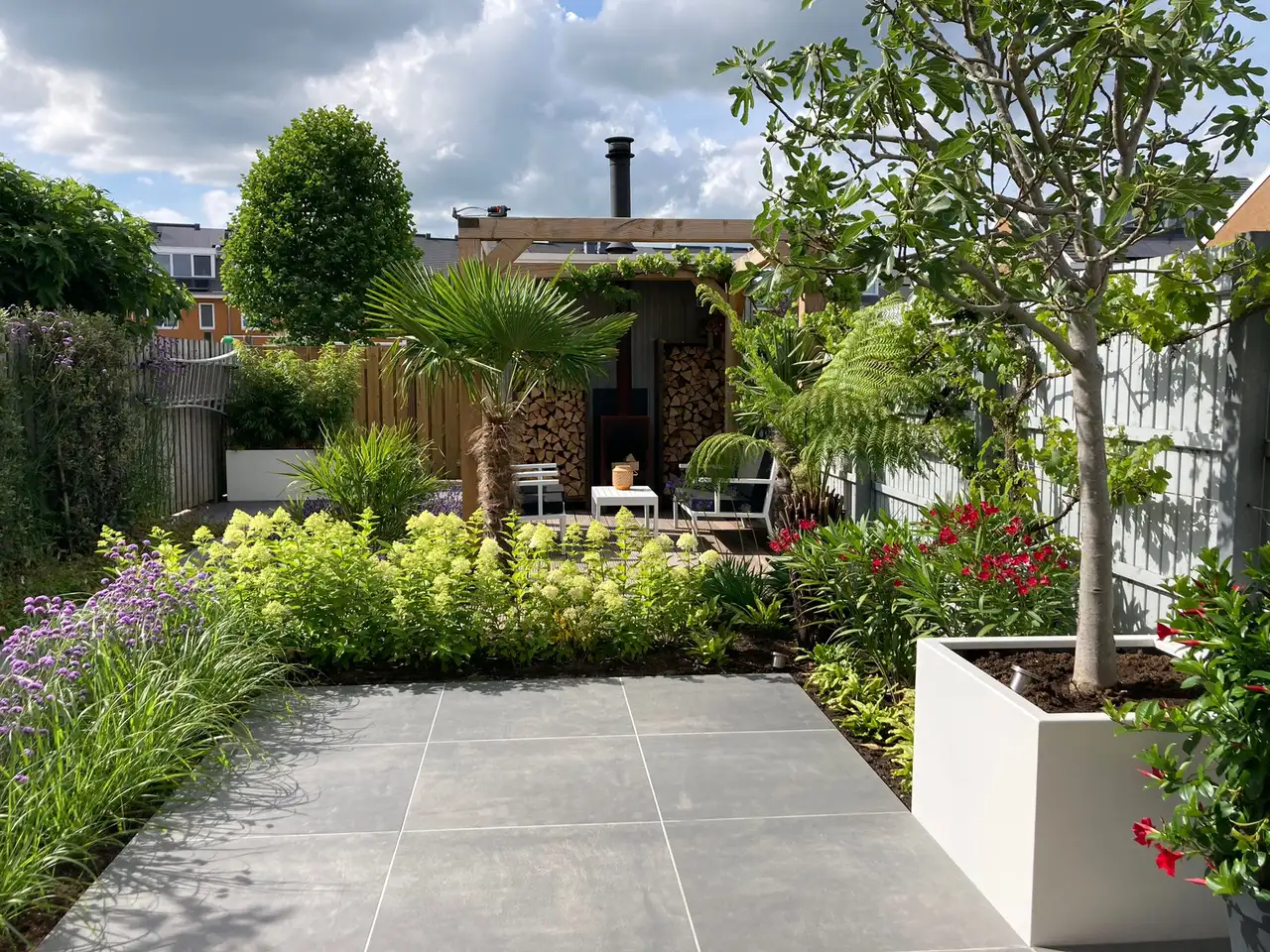
With a gardener who also does paving work, the hardscaping is planned together with the rest of the garden: planting beds, drainage, and water directed towards the borders rather than the boundary fence.
What does a paving contractor cost per m²?
Price depends heavily on material and how complex the stone is to lay. All-in (labour, sub-base, material) 2026 guide prices:
| Material | Guide price per m², installed |
|---|---|
| Concrete pavers / slabs | €50 – €90 |
| Standard fired-clay bricks | €60 – €100 |
| Oud-Waalse klinkers | €70 – €120 |
| IJsselsteentjes | €75 – €130 |
| Kinderkopjes (natural stone) | €90 – €160 |
Small, irregular stones such as kinderkopjes and IJsselsteentjes take more labour hours per m² than large slabs - that's where most of the price gap comes from. Always ask for a site-specific quote; the exact price depends on the area, the condition of the existing sub-base and site access.
Traditional Dutch paving: oud-Waalse klinkers, IJsselsteentjes and kinderkopjes
For gardens at heritage or characterful homes - or simply for an authentic look - more clients are choosing traditional Dutch street stone instead of standard concrete pavers:
- Oud-Waalse klinkers - small, weathered-looking clay bricks for a rustic, decades-old finish.
- IJsselsteentjes - small hand-formed bricks, traditionally used in restoration and heritage paths.
- Kinderkopjes - natural-stone cobblestones, extremely durable and water-permeable.
All three demand more craftsmanship than standard clinkers: smaller formats, irregular sizing and, with reclaimed stone, varying thickness. A poorly built sub-base shows up faster with these materials than with large, flat slabs.
Paving a difficult garden or awkward ground
Not every garden is a flat rectangle. Level changes, high groundwater, old sunken paving or a narrow, irregular plot all call for a tailored foundation and laying pattern. See our guide on tackling a difficult garden for the most common problems and fixes, or request a free, no-obligation inspection.
What to check when choosing a paving contractor
- Sub-base build-up: ask how thick the crushed-stone foundation will be (at least 15–20 cm for footpaths, more for driveways with car traffic) and what levelling sand is used.
- Fall/drainage: a patio or path needs at least 1.5–2 cm of fall per metre, away from the house, so water never pools.
- Utility location check (KLIC): excavation deeper than a few centimetres legally requires a utility check in the Netherlands. A serious contractor arranges this before starting.
- Warranty: ask explicitly about a sinking/settlement warranty - it tells you a lot about how confident the contractor is in their own foundation work.
Frequently Asked Questions
What is the difference between a paving contractor and a gardener?
A paving contractor specialises in hardscaping: patios, paths and driveways. Many gardeners also do this work, but additionally consider how it connects with planting, drainage and the rest of the garden. For a complete garden where paving and greenery need to work together, a gardener with paving experience is usually the more practical choice.
Can existing paving stone be reused?
Often yes, provided the stones are undamaged. Reuse is especially common with oud-Waalse klinkers, IJsselsteentjes and kinderkopjes - the weathered look of reclaimed stone is actually desirable. We assess reuse potential during the site visit and what it saves on material cost.
How long does paving an average patio take?
A patio of 20–30 m² in standard pavers or clinkers typically takes 1–2 working days. With traditional materials such as kinderkopjes or IJsselsteentjes, or on difficult ground, expect 2–4 working days due to the extra laying time.
Hovenier Hoofddorp is your gardener for the greater Amsterdam area - from garden landscaping and garden maintenance to premium villa gardens with pools, nationwide. Fixed prices, reply within 24 hours.
Rather leave it to us? Request a quote.
We are happy to visit you for honest advice and a clear price. No hassle - just a well-kept garden, with everything explained in English.
Fast Response
We always respond within 24 hours, so you quickly know where you stand.
Professional Results
We work neatly and always leave your garden tidy. A deal is a deal.